Friday, September 20, 2013

Final Project: eMotion "Rush Hour"

Research
Source: Wikipedia
Traffic Congestion
            Traffic congestion is described to be the condition due to increase of road users. This is characterized by slower speeds, longer commute times and increased vehicular queuing. When demand of road users nears the road capacity, this will cause traffic jams or congestions.
Causes
            The cause of traffic congestion is when the amount of road users nears the capacity of the road. This cause demands for bigger roads or highways to cope with the high traffic volume. Other causes could be layout of the road itself. For example in a crowded Asian city, wide roads that converge into smaller streets can cause congestion or a ‘bottleneck’ in traffic flow.
Negative affects
            There are a number of negative affects due to traffic congestion. Some include delays, time waste for commuters, inability to predict travel times, pollution and road rage.

Urban Sprawl
            Urban sprawl or suburban sprawl is a multifaceted concept centered on the expansion of auto-oriented, low-density development. Topics range from the outward spreading of a cityand its suburbs, to low-density and auto-dependent development on rural land, examination of impact of high segregation between residential and commercial uses, and analysis of various design features to determine which may encourage car dependency. The term "sprawl" is most often associated with US land use; outside the US (and especially outside the Anglosphere), the term "peri-urbanisation" is often used to denote similar dynamics and phenomena.[citation needed]
Discussions and debates about sprawl are often made unclear by the uncertainty of the meaning associated with the phrase. For example, some commentators measure sprawl only with the average number of residential units per acre in a given area. But others associate it with decentralization (spread of population without a well-defined centre), discontinuity (leapfrog development, as defined below), segregation of uses, and so forth.
The term urban sprawl generally has negative connotations due to the health, environmental and cultural issues associated with the phrase. Residents of sprawling neighbourhoods tend to emit more pollution per person and suffer more traffic fatalities. Sprawl is controversial, with supporters claiming that consumers prefer lower density neighborhoods and that sprawl does not necessarily increase traffic. Others have argued that sprawl is less a reflection of consumer preferences and more a result of legal structures and court decisions that have encouraged sprawl development.
Emotion Portrayed
Exhaustion and Fatigue
            Fatigue (also called exhaustion, tiredness, lethargy, languidness, languor, lassitude, and listlessness) is a subjective feeling of tiredness which is distinct from weakness, and has a gradual onset. Unlike weakness, fatigue can be alleviated by periods of rest. Fatigue can have physical or mental causes. Physical fatigue is the transient inability of a muscle to maintain optimal physical performance, and is made more severe by intense physical exercise. Mental fatigue is a transient decrease in maximal cognitive performance resulting from prolonged periods of cognitive activity. It can manifest as somnolence, lethargy, or directed attention fatigue.
Medically, fatigue is a non-specific symptom, which means that it has many possible causes. Fatigue is considered a symptom, rather than a sign because it is a subjective feeling reported by the patient, rather than an objective one that can be observed by others. Fatigue and ‘feelings of fatigue’ are often confused.


Persona

            The persona portrayed in the video is an individual, most likely a working individual who spends so much time commuting from work to home due to the traffic congestion of rush hour. Due to the fact this persona has to go through the same congestion almost every day, the persona becomes somewhat exhausted, loses focus, and becomes mentally tired.

Target Audience
            The video artwork is targeted to an audience who lives and works in urban areas. Mostly working class people ages 20-50.


 Artist’s Statement
            This video mostly takes place at a stretch of highway in Puchong where it is known to be very congested. Firstly it takes in a bit of sound and views urban commute in a third person perspective. This shows the mass numbers of people who commute during rush hour every day. Time lapse video and the use of two time settings (5.00 pm and 8.00 pm) is to show that the rush hour will not end until very late at night due to the large population and urban sprawl of an Asian city. (Particularly Kuala Lumpur).

Thursday, September 5, 2013

Assignment 3: Extreme Emotion: Grit

Research
Source: Wikipedia
Grit
Grit in psychology is a positive, non-cognitive trait, based on an individual’s passion for a particular long-term goal or end state coupled with a powerful motivation to achieve their respective objective. This perseverance of effort promotes the overcoming of obstacles or challenges that lie within a gritty individual’s path to accomplishment and serves as a driving force in achievement realization. Commonly associated concepts within the field of psychology include "perseverance," "hardiness," "resilience,” “ambition,” “need for achievement” and conscientiousness. These constructs can be conceptualized as individual differences related to the accomplishment of work rather than latent ability. This distinction was brought into focus in 1907 when William James challenged the field to further investigate how certain individuals are capable of accessing richer trait reservoirs enabling them to accomplish more than the average person, but the construct dates back at least to Galton, and the ideals of persistence and tenacity have been understood as a virtue at least since Aristotle. Although the last decade has seen a noticeable increase in research focused on achievement-oriented traits, there continues to be difficulty in aligning specific traits and outcomes.

Grit is defined as “perseverance and passion for long-term goals.” Building upon biographical collections of famous leaders in history, researchers and scientists have reached similar conclusions about high achieving individuals. Specifically, those individuals who were deemed more successful and influential than their contemporary counterparts typically possessed traits above and beyond that of normal ability. While ability was still critically important, these individuals also possessed “zeal” and “persistence of motive and effort.” Duckworth and colleagues (2007) believe this dual-component of Grit to be a crucial differentiator from similar constructs. Grit is conceptualized as a stable trait that does not require immediate positive feedback. Individuals high in Grit are able to maintain their determination and motivation over long periods despite experiences with failure and adversity. Their passion and commitment towards the long-term objective is the overriding factor that provides the stamina required to “stay the course” amid challenges and set-backs. Essentially, the Grittier person is focused on winning the marathon, not the sprint.

Mixed Martial Arts. (MMA)
            Mixed martial arts (MMA) is a full contact combat sport that allows the use of both striking and grappling techniques, both standing and on the ground, from a variety of other combat sports. The roots of modern mixed martial arts can be traced back to the ancient Olympics where one of the earliest documented systems of codified full range unarmed combat was in the sport of pankration. Various mixed style contests took place throughout Europe, Japan and the Pacific Rim during the early 1900s. The combat sport of vale tudo that had developed in Brazil from the 1920s was brought to the United States by the Gracie family in 1993 with the founding of the Ultimate Fighting Championship (UFC).
The more dangerous vale-tudo-style bouts of the early UFCs were made safer with the implementation of additional rules, leading to the popular regulated form of MMA seen today. Originally promoted as a competition with the intention of finding the most effective martial arts for real unarmed combat situations, competitors were pitted against one another with minimal rules. Later, fighters employed multiple martial arts into their style while promoters adopted additional rules aimed at increasing safety for competitors and to promote mainstream acceptance of the sport. The name mixed martial arts was coined by television critic Howard Rosenberg, in 1993, in his review of UFC 1. The term gained popularity when the website newfullcontact.com, then one of the biggest covering the sport, hosted and reprinted the article. Following these changes, the sport has seen increased popularity with a pay-per-view business that rivals boxing and professional wrestling.


Artist Statement
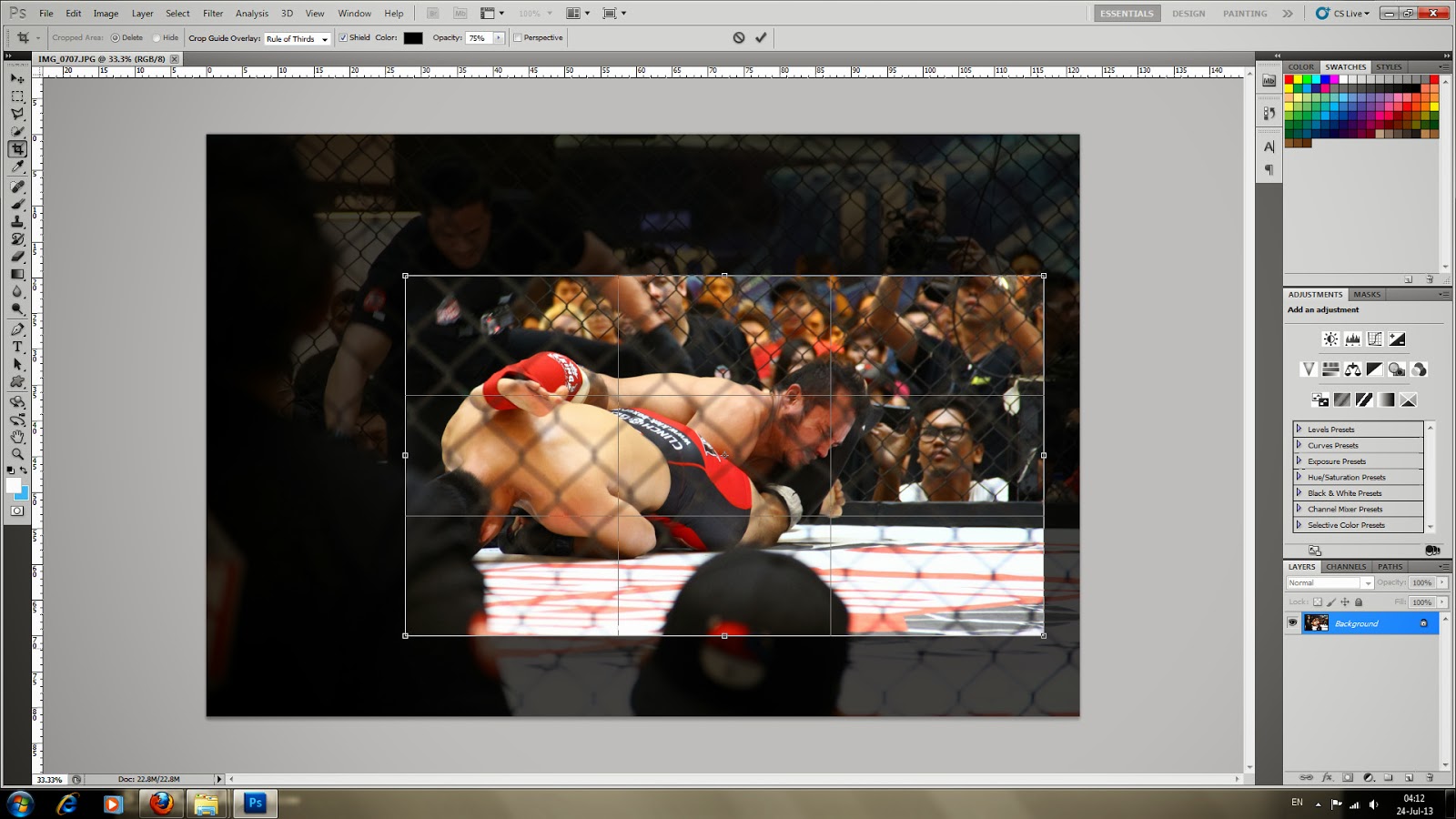
            Through the artwork, we can see I used a photograph of a Mixed Martial Arts (MMA) match. The photo was first edited and only maintains two colours which are white and red. This was done because through the expression of the fighter, we can see he is trying with all his abilities to win. It was edited in a threshold style to make the image stand out more. After the photo was printed, the print out was splashed with red paint to resemble blood because in a fighting situation, blood will always spill if a fight continues for an amount of time.


Thursday, July 25, 2013

Assignment 2 : Be Water, My Friend.

Research
Source: Wikipedia
Who is Bruce Lee

            Bruce Lee who was born 27 November 1940 was a Hong Kong – American martial artist, actor and martial arts instructor. He was the son of Cantonese opera star, Lee Hoi Chuen. He was also credited to be the person who changed the way Asians were presented in American films. He initially trained in Wing Chun Kung Fu but later rejected the style. Instead he mixed styles from various sources and later was dubbed as Jeet Kune Do (way of the intercepting fist). He was considered an innovator in film and martial arts through bringing people together regardless of race and religion. Through his interest in philosophy and martial arts, many motivational quotes can be traced back to Bruce Lee. Sadly he died at an early age in Kowloon Tong on 20 July 1973 at the age of 32.
“Be Water My Friend”
            The quote “be water my friend” can be traced back from the “Longstreet” TV series. The full original quote was “Empty your mind…be formelss, shapeless, like water. If you put it in a cup, it becomes the cup. If you put it in a teapot, it becomes the teapot. Now water can flow or creep or drip or crash. Be water, my friend”. The meaning behind the quote is that in order to win a fight or to resolve any situation in the best way, we must adapt to the surroundings and the situation in any way possible to achieve something. According to him, no two situations are alike. This quote is considered Bruce Lee’s most well-known quote ever.   

Artist Statement
            The words used for the Type Expression artwork is the words from the ‘be water my friend’ quote. The background is red to reflect Bruce Lee’s bold personality and charisma from during his lifetime. The words “Formless Shapeless Like Water” is warped and formed to portray Bruce’s face and neck in white. Whereas his famous yellow jump suit (featured in his last film ‘Game of Death’) contains the words “Be Water My Friend”. The hair and hands are only vectors to give the complete form of Bruce Lee.


Thursday, July 11, 2013

Assignment 1: Running on Fuel

Research
Source: Wikipedia
Fossil Fuels
            Fossil fuels are fuels formed by natural processes such as anaerobic decomposition of buried dead organisms. The age of the organisms and their resulting fossil fuels is typically millions of years, and sometimes exceeds 650 million years. Fossil fuels contain high percentages of carbon and include coal, petroleum, and natural gas. They range from volatile materials with low carbon hydrogen ratios like methane, to liquid petroleum to nonvolatile materials composed of almost pure carbon, like anthracite coal. Methane can be found in hydrocarbon fields, alone, associated with oil, or in the form of methane clathrates. The theory that fossil fuels formed from the fossilized remains of dead plants  by exposure to heat and pressure in the Earth's crust over millions of years  was first introduced by Georg Agricola in 1556 and later by Mikhail Lomonosov in the 18th century.
The Energy Information Administration estimates that in 2007 the primary sources of energy consisted of petroleum 36.0%, coal 27.4%, and natural gas 23.0%, amounting to an 86.4% share for fossil fuels in primary energy consumption in the world. Non-fossil sources in 2006 included hydroelectric 6.3%, nuclear 8.5%, and others (geothermal, solar, tidal, wind,wood, waste) amounting to 0.9%. World energy consumption was growing about 2.3% per year.
Fossil fuels are non-renewable resources because they take millions of years to form, and reserves are being depleted much faster than new ones are being made. The production and use of fossil fuels raise environmental concerns. A global movement towards the generation of renewable energy is therefore under way to help meet increased energy needs.

The burning of fossil fuels produces around 21.3 billion tonnes (21.3 gigatonnes) of carbon dioxide (CO2) per year, but it is estimated that natural processes can only absorb about half of that amount, so there is a net increase of 10.65 billion tonnes of atmospheric carbon dioxide per year (one tonne of atmospheric carbon is equivalent to 44/12 or 3.7 tonnes of carbon dioxide). Carbon dioxide is one of the greenhouse gases that enhances radiative forcing and contributes to global warming, causing the average surface temperature of the Earth to rise in response, which the vast majority of climate scientists agree will cause major adverse effects.

Artist’s Statement
            Firstly, the background chosen is yellow to resemble the colour of petrol. The petrol pump takes one side to show a source for people to get fuel. This is considered the thing that controls society today. The person next to the petrol pump is pumping petrol into his head because in society, whatever happens to petrol price, tax or whatsoever will have big affects on society. This shows today’s society is literally running on fuel.